
Vibe coding as a new business advantage
TL;DR: Companies use many distributed systems, vibe coding allows you to create a layer integrating these systems, automating common process steps, and adjusting the interface to expose what your team really needs to see. This speeds up your teams, removes busy work, and unlocks massive business advantages.
The status quo
Teams work with many different tools. Examples of tools: the UPS interface, the company ERP system, CRM systems, ticket systems.
Data lives in each systems individually – a situation known as “silo”, and teams shuttle data between systems.
This data shuttling and modification constitutes your business processes. They execute in the heads of your teams, however, they might not be fully documented, or not up-to date.
As the tools evolve, the employees have to keep up and adjust how they use the tools. As the regulations evolve, additional steps are added.
Running a business becomes increasingly complex and brittle.
Some tools remove functionality which your team used to depend on.
Moving away from tools becomes increasingly complex, as your team is locked into their usage habits. Re-skilling them is not an option in these times of intense competitive pressure and increasingly short deadlines.
The dead end: a new unified mega-tool
Companies often search for a tool which will cover all their needs.
It’s like having a manager who is skilled in every area of the business, and will be able to handle marketing, run manufacturing, sales, lead teams, and raise money.
Not going to happen.
Tools are typically developed with a target audience in mind. As such, they are like clothes which need to fit people with all kinds of frames. No person will be clothed with a perfect fit.
You will find these tools constrain you and your team in myriad ways. They require work-arounds, and your process and team to fit the tool, rather than the other way around. You find yourself turning down business because it doesn’t fit into the mould of what the tool can do, rather than what the team could potentially do.
The other dead-end: 100 % custom bespoke software
Building and testing functionality takes time and experience. There are many choices to make, including the right database system, user interface decisions, how to wrap functionality. Tools, for example billing software, need to comply with local regulations.
The workload, and dangers to build your own 100 % bespoke software is just too big; there is a value which tool makers and professional companies add – they have domain knowledge, and encode it into their software.
Thus:
Instead of building your own shop software frontend, you use Shopify.
Instead of building your own operating system, you use Microsoft Windows.
Instead of training your own AI frontier model, you use Claude.
The middle ground: a thin vibe-coded UI and automation layer on top of your legacy tools
The sweet spot: have your cake and eat it, too.
Creating a thin vibe-coded UI and automation layer on top of your legacy tools, using their APIs, has many advantages:
- Your team can use them in addition to the existing tools, but doesn’t have to – there is a fallback to familiar interfaces
- Instead of being a “black box”, the AI interface is perceived as an orchestration layer, which shuttles information between the systems
- The new AI tool does not have to start from scratch – it can work with existing customer data, existing systems
- If done correctly, it is perceived as removing hurdles, making things easier, removing repeated click paths, and annoying copy & paste work by your colleagues
- The tool can continue to evolve continuously, as a thin translation layer, while the customer data is stored in safe and proven systems.
- You can react quickly to team needs, regulatory developments, and market developments – thus outpacing your competition. If you don’t do it, they might.
- The tool will be able to integrate into further systems with ease, allowing you to increase revenue and profits
- Friction is removed from processes – ensuring higher compliance in your team, and a better morale, as team members can focus on their actual competencies and value added tasks, rather than having to babysit tools and systems.
Example 1: Job posting application
As an example of what is possible, see this screenshot:
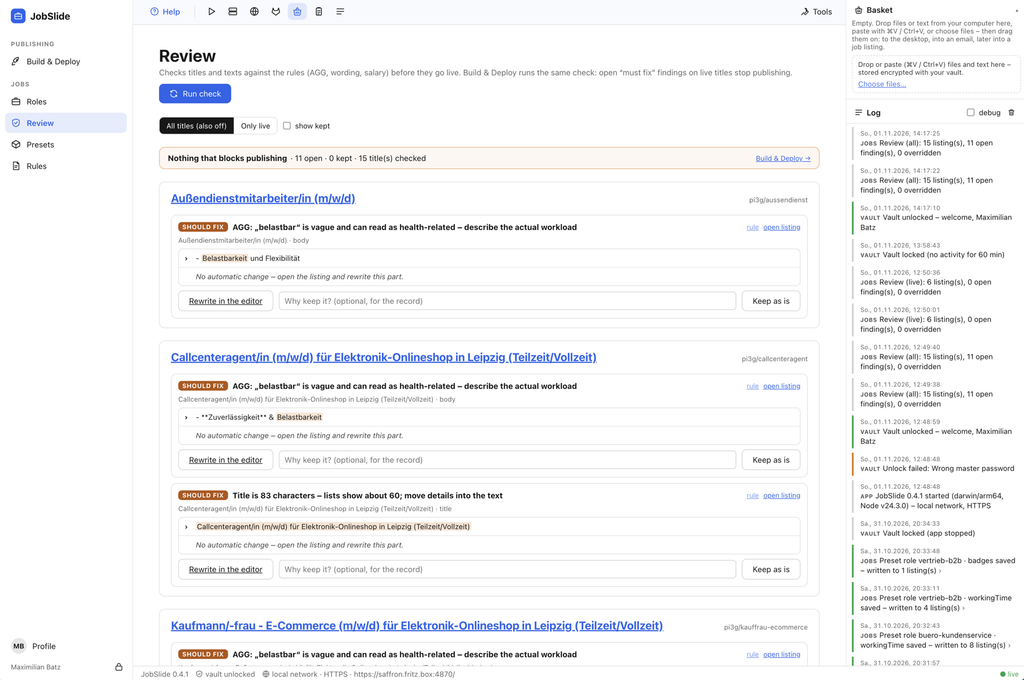
Posting jobs used to be a very manual task with many copy & paste steps.
It required posting to many interfaces, copying text from one place to another, while adjusting it.
So, we automated it, using traditional software development techniques.
However, it still required many manual steps, and relied on people checking the postings, carrying their own domain knowledge (for example, in Germany you are not allowed to hire by gender or age – there are laws against discrimination of applicants).
For example, in order to publish a new job posting, we would have to edit several files. Then check the result output (generated by a separate software tool). It needed to be uploaded to our server using a special secure connection, and deployed. Then, the ad would be picked up by an external system, and distributed across several job platforms.
Every action required several clicks, text editing, ensuring that all the pieces work correctly – and also waiting for some results to finish.
A very manual process. Before vibe-coding reached the quality it has today, further automation seemed like a waste of time.
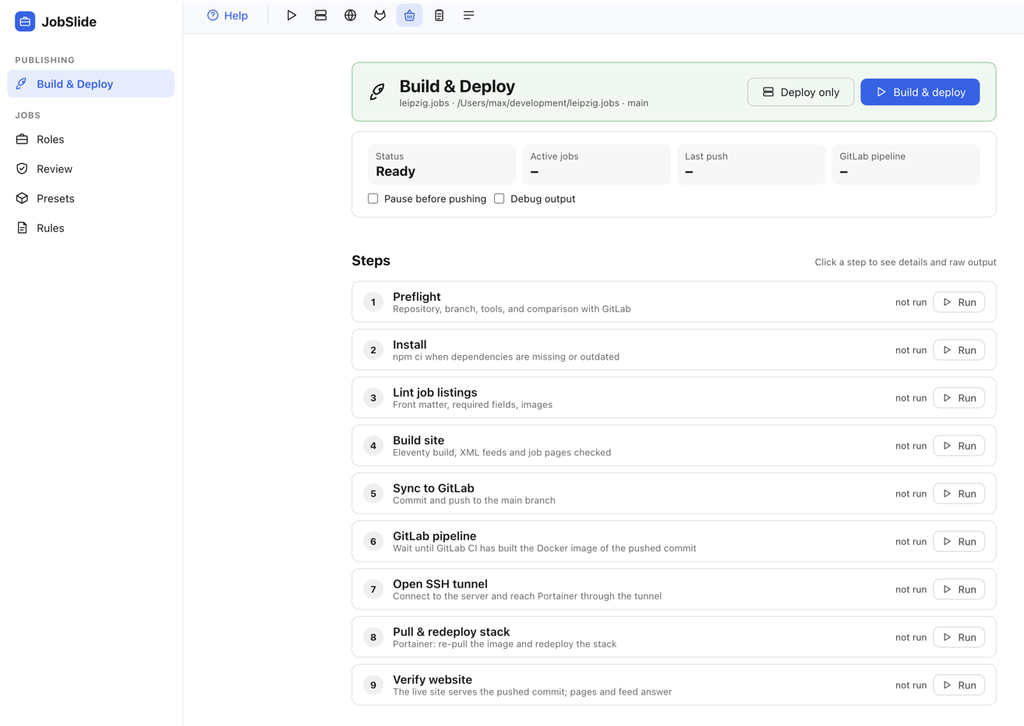
The image above shows the steps needed to deploy the job, after it has been written and prepared. Now the vibe-coded tool runs them at the click of one button. Including managing the necessary secret credentials.
With vibe coding, such processes can be automated. Removing the friction, to unlock what should be done in the company is transformative.
Furthermore, additional integration with external systems is possible, which had been run manually – or, in many cases, not at all.
In our example, the tool could integrate with Google Jobs, WordPress, and other job platforms. Thereby increasing reach, and our likelihood of finding the right person for the job.
Note, this is an internal tool we are developing for ourselves – previously this type of complexity and software engineering would not have been thinkable. Vibe coding is unlocking it.
Also note: we are not re-inventing the wheel completely. We are not building our own super-tool which completely eliminates the need for external aggregators, or which bypasses WordPress completely. We do not build our own Docker interface to control the server.
We are building a tool which integrates several external systems in a way which we need, encoding repeatable business processes in the user interface.
Stripping away repetitive steps, and adding new functionality. The time saved in clicking can now be invested in compliance processes, optimizing the ads, extending the reach, etc.
Example 2: ticket to customer
The tool has it’s origins in a common frustration:
You get many requests via e-Mail, via web forms, and other sources. Customers post their data in these tickets – sometimes part of the data lives on web pages.
In order to create offers, and communicate with the customers, you need to import the data into external systems.
This typically involves a team member going through the ticket, copy-pasting information, and reasearching missing data on the website of the company contacting your organization.
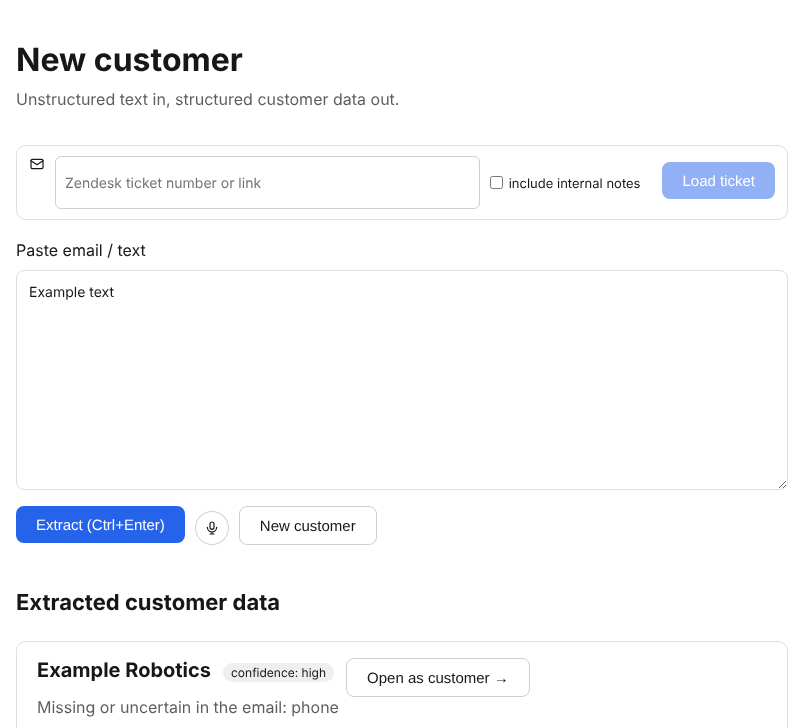
A good job for AI automation. With our tool, we allow our team members (users) to post the ticket into the interface – or directly import it using a Zendesk ticket number or link.
The ticket is processed through an AI system, which extracts the customer data.
The user can edit the customer data, and also press a button to automatically research their website and augment the data.
Subsequently, they can check if the customer already exists in our billing tool (easybill), or if they are completely new. With another click, the customer data can be imported into easybill.
A frustrating process, which does not leverage human creativity, skills and other good qualities which your team members bring to your organization, has been turned into a pleasant interaction with the new vibe coded AI automation tool.
Since our team is trained on easybill (the invoicing system), they can continue to leverage their skills with the tool.
easybill’s own interface does not matter as much as it used to anymore. We can ignore the functionality we don’t need, and present our users strictly only the things they need for their work. Automating what can be automated.
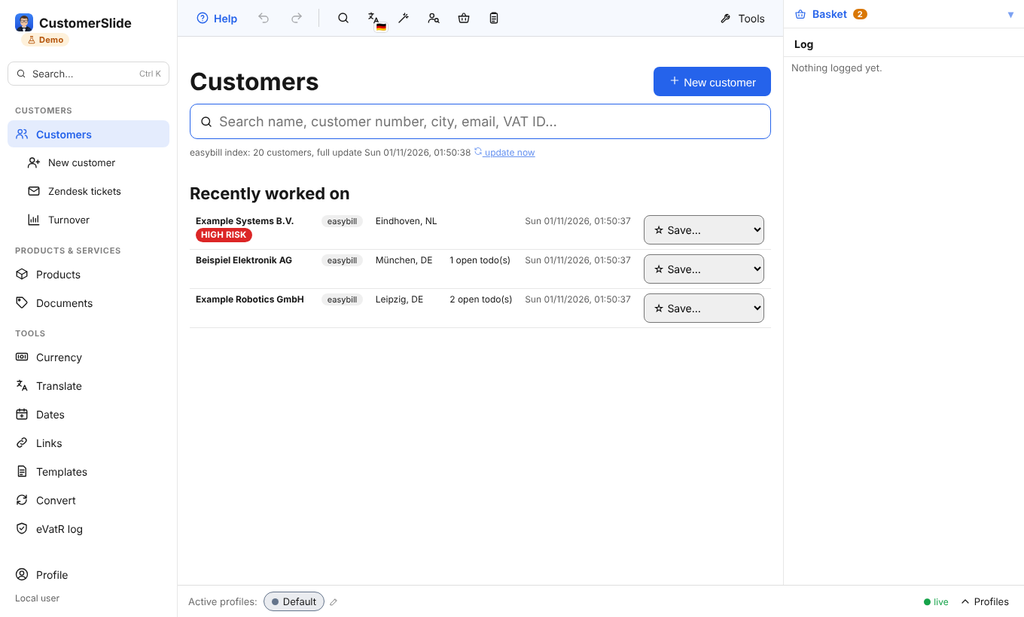
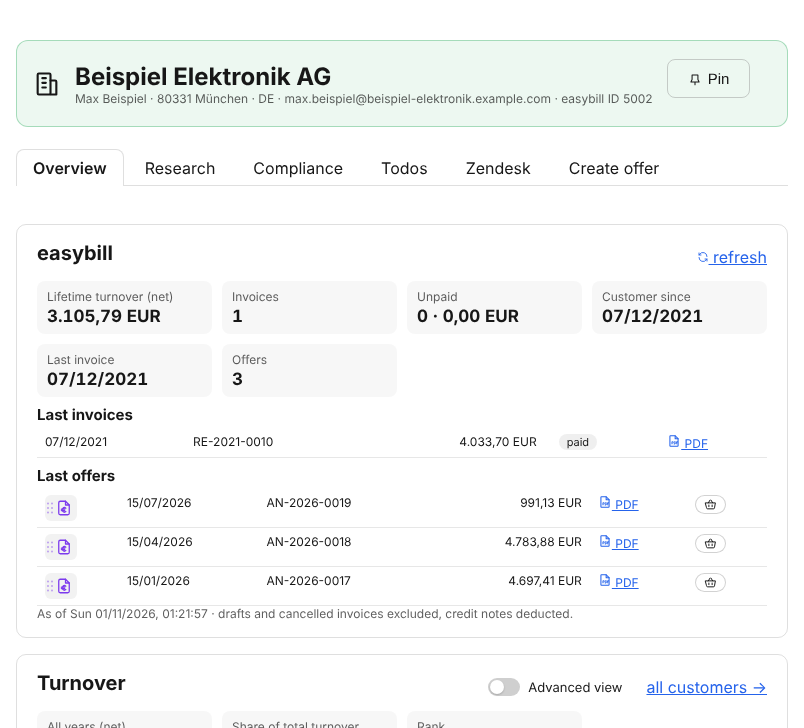
Additional functionality can be added on top, which was previously in manual processes, thereby streamlining and formalizing them:
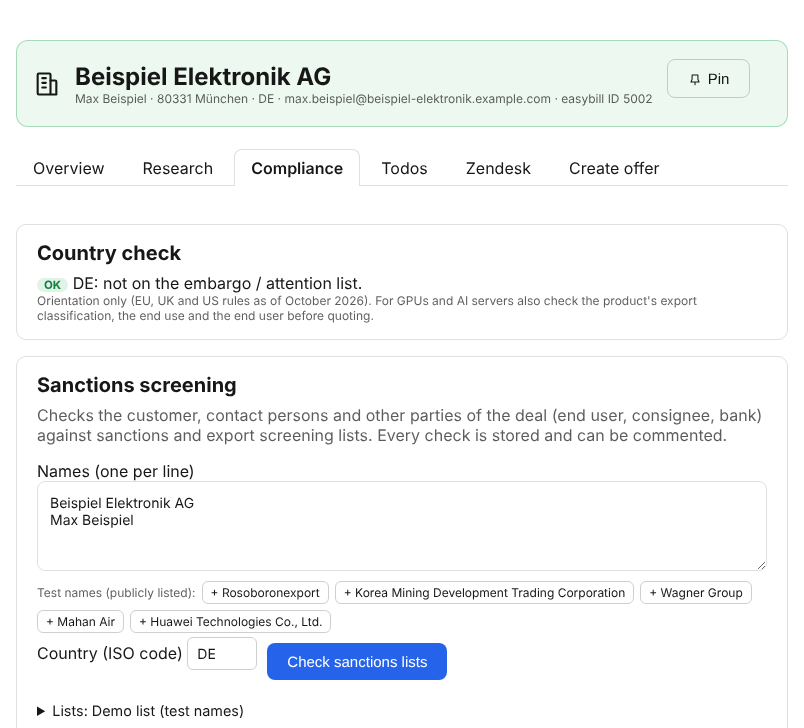
in this example, a new sanctions screening process has been implemented. The AI tool automatically checks for matches against sanctions databases. As the sanctions process in our company evolves, we can adjust the sanctions screening tool quickly – iterating it, and quickly following regulation changes, and the availability of new databases, instead of lagging behind and exposing ourselves to risks.
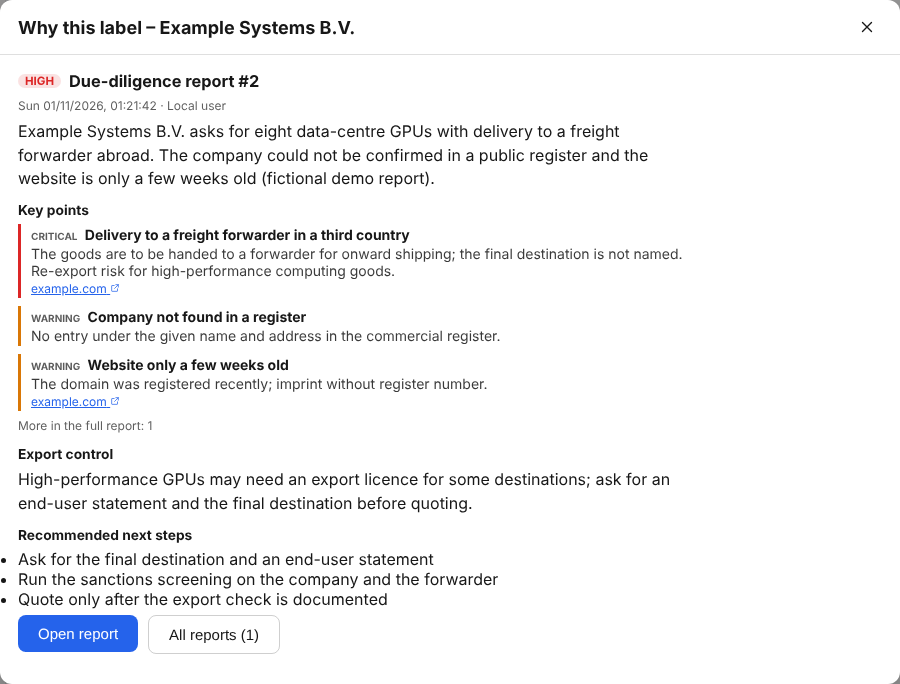
Another way the tool can reduce your exposure to risk is by screening customers automatically – at a scale and cost which would be impossible to achieve with leveraging your already overworked team members.
Instead, we augment existing processes, streamline the time the team uses on low value copy & paste tasks, and instead allow them to unlock additional, higher value-add checks and processes. To drive the bottom line, lower risk, increase team productivity – and – most important: team and customer happiness.
When is vibe coding based automation possible?
Whenever your systems have APIs and interfaces, as the example tools presented here, they can be automated by vibe coding.
However, not all vibe coded interfaces are comparable.
To create tools your colleagues will love requires to have imagination, be able to listen well to their needs, and lived processes. It requires an understanding of human psychology, rather than coding skills.
The ability to predict what additional UI elements would be useful, even if your team members never explicitly mention them. To build truly beloved tools, which your team will enjoy using.
On the coding side, defensive practices, such as introducing a vault for secrets, having a log for business and technical processes, and ensuring the tool is only accessible by your team, matter.
At Deutsche AI Consulting we specialize in providing your teams with vibe-coded applications, on a subscription base. The tools continue to evolve with you and your team. There is always someone to fix mistakes, and errors, and react to your team’s input.
The tool unfolds with you, and the dynamic, ever-evolving market.
Contact us today for a quote for our vibe code automation service subscription. It is surprisingly affordable, and will unlock happy teams, increased profits, and happier customers.